Showing posts with label retro. Show all posts

Thursday, 17 December 2015

Corn Bread with Radish (Makkai ki Roti) [Classic Indian Vegetarian and Grain Cooking]


This cornstarch roti from the Indian Vegetarian cookbook is one of those recipes where I kept on saying "that can't be right, that's not going to work, this is clearly the wrong texture", and yet, I'm glad I stuck with it exactly, because it turned out actually pretty well!

Cookbook Recipe:


Ingredients:

  • 1 cup packed grated daikon radish (don't press the water out of it)
  • 1/2 tsp coarse salt
  • 1 cup "fine ground corn flour" (this is the British term for cornstarch)
  • 5 tbsp water
  • 4 tbsp unsalted butter

Following the cookbook recipe exactly:

Is it supposed to be this soupy? It still works, though.
1. In a bowl, mix the radish and salt. Add the cornstarch and mix well with your fingers, pressing the water out of the radish. Add the water 1 tbsp at a time, mixing well. The "dough" turns pretty soupy at this point, and it's kind of hard to "divide it into 8" when it's mostly liquid.


2. Cut 9x9 inch pieces of wax paper and have a bowl of water handy to wet fingers. Spread an eight of the dough into a thin 5 inch round circle on the wax paper.

Again, it shouldn't work, but it does.

3. Heat a frying pan over medium for 3 minutes. Carefully flip the round onto the griddle with the paper still attached and peel the wax paper off. Cook on one side for 3 minutes, the other side for 2.


4. Add 1 1/2 tsp butter and fry the bread for 1 minute on each side. Repeat for the rest of the batch.

The Outcome:


This actually works! I was expecting it to be a runny mess, but as soon as it hit the heat, it came together into a solid roti. It fried up nicely, and I really liked the slightly glutenous texture from the cornstarch. My only problem is that most of the water evaporates in the first few minutes, so one side stays a bit harder and paste-white. Frying it in the butter helps brown it a bit.

Tuesday, 15 December 2015

Low-Calorie Papaya Drink (Papeeta Lassi) [Classic Indian Vegetarian and Grain Cooking]


Papaya isn't a flavour of lassi that I've come across too often (mango or yogurt seem to be the standard), so this looks interesting - especially with nutmeg added to the mix. This recipe does make me think - if this is "low calorie" for a lassi, how many calories are in a regular one?

Cookbook Recipe:


Ingredients:

  • 1/2 "overflowing" cup of papaya flesh, in 1/2 inch to 3/4 piece pieces (pretty much exactly half of a small papaya)
  • 3/4 cup low fat buttermilk
  • 2 tbsp honey or sugar
  • 1/4 tsp coarse salt
  • pinch of nutmeg
  • 1/4 cup water
  • 4 "standard size" ice cubes

Following the cookbook recipe exactly:

1. In a blender, mix the papaya, buttermilk, honey, salt, and nutmeg. The cookbook calls for you to blend it for 1 1/2 minutes or until thoroughly blended, this cookbook is 30 years old, a modern blender will have that done in a few seconds.


2. Add water and ice and blend until frothy. The cookbook warns the ice cubes won't disintegrate fully, but they did in my blender.

The Outcome:


This is a really good lassi - papaya isn't a flavour that gets used too often, but it's nice and subtle. The nutmeg really makes this recipe - it goes well with the papaya and keeps the lassi from being too cloying. While I'm sure this is healthier than a normal lassi, I still wouldn't count it as health food. It definitely doesn't taste watered down!

Sunday, 13 December 2015

Cracked Wheat Porridge with Almonds and Apricots (Dalia) [Classic Indian Vegetarian and Grain Cooking]


The vegetarian Indian cookbook seems to lean heavily towards northern Indian dishes, including this bulgur breakfast porridge from along the Pakistani border. This recipe is definitely a lesson in making sure things don't burn - get ready for a lot of stirring!

Cookbook Recipe:


Ingredients:

  • 2 tablespoons sweet butter (this isn't clearly explained in the cookbook, but it's meant to be normal butter, as opposed to salted butter or ghee)
  • 1 cup bulgur wheat 
  • 3 1/2 cups milk
  • 2 cups water
  • 1/2 cup dried apricots, cut small
  • 3 tbsp jaggery or honey
  • 1/2 cup blanched sliced almonds, toasted (dry toast them in a pan)
  • scalded milk and jaggery/honey on the side

Following the cookbook recipe exactly:


1. Melt the butter in a medium saucepan. Add the bulgur and fry in the butter over medium-high heat for about 10 minutes until browned. The recipe says "stir often", and they do mean often, since after the 5 minute mark there's a good chance the wheat will burn if you let it sit too long.


2. Add the water, 2 cups of the milk, and the apricots - bring to a boil. Lower head and simmer for 15 minutes uncovered, stirring often. Turn off the heat, cover the pot, and let sit for 10 minutes.

3. Add in the rest of the milk, the honey/jaggery, and mix well over low heat to warm it back up. Top with the nuts and serve with extra milk and sweetener on the side.

The Outcome:


This is a mildly sweet, milky porridge. It's pretty good - toasting both the almonds and browning the bulgur means that it has a nice nutty taste. You lose a lot of the apricot flavour from the boiling, however - if I made this again, I'd probably add in the apricots later. I'm not entirely sure about the texture, adding in the extra milk makes it very soupy and since this dish is new to me, I'm not sure if it's meant to be like this - it really didn't need any extra milk added to it. I do want to rustle up some jaggery and see if that changes the flavour compared to honey. Maple syrup would also work really well as a topping for this.

Friday, 11 December 2015

Fiery Mint, Green Chili, and Onion Relish (Podina Piaz) [Classic Indian Vegetarian and Grain Cooking]


The author of Classic Indian Vegetarian and Grain Cooking warns that this relish is going to be spicy, and I'm pretty pleased to have found a cookbook where they actually mean it. It's basically ground chilies with a bit of extra ingredients for flavour and body and it packs a wallop.

Cookbook Recipe:


Ingredients:

  • 2 cups thinly sliced onion (preferably red)
  • 2 medium tomatoes, blanched, peeled, and quartered
  • 12 (yes, twelve!) hot green chilies (I went for my old favourite - serrano peppers)
  • 1/4 cup coarsely chopped cilantro
  • 1/4 cup fresh mint leaves
  • 3/4 tsp coarse salt to taste

Following the cookbook recipe exactly:


1. Put the sliced onions in a bowl, then put half the tomatoes in the blender and add "all the other ingredients" except the salt. The cookbook seems to imply that you don't blend the onions, but isn't completely clear on the point. Blend until pureed.

When just opening the lid makes your eyes water, you're in for a good time.

2. Add the rest tomatoes and chop for a few seconds, just to chop the tomatoes roughly.

3. The recipe ends here, but presumably you then mix the puree with the onion and add the salt.

The Outcome:

Welcome to Fire Town, population: me.

I put this on top of some plain rice and peas, just to make sure I got the full flavour. This is wonderfully, gloriously, brutally spicy. Once again, the recipe's steps weren't completely clear, but the result was really good. I'm a big spice head and this had me sweating. The mint and cilantro add a bit of extra flavour, but mainly the combination of raw onion and hot chilies takes you by the throat. This relish also seems really versatile, you could top pretty much anything - rice, fish, chicken, pakoras, samosas, etc - with it and it would work. The book's explanatory notes explain that "hot green chilies" can cover pretty much anything from serrano and jalapeno peppers to milder anaheims, so there's wiggle room here for non-spice heads.

Wednesday, 9 December 2015

Cauliflower, Eggplant, and Potato in Herb Sauce (Sabzi Korma) [Classic Indian Vegetarian and Grain Cooking]


First up from the Classic Indian Vegetarian and Grain Cooking is sabzi korma, a northern Indian dish with the cumbersome English name "Cauliflower, Eggplant, and Potato in Herb Sauce". I like the big spread of spices involved - that's a good sign in my books. The use of almonds is new to me, but I like where this idea is going.

Cookbook Recipe:


Ingredients:

  • 6 tbsp light vegetable oil
  • 1 1/2 cups minced onion (pretty much one medium-large onion exactly)
  • 2 tsp minced garlic (about 1 or 2 cloves)
  • 2 tbsp grated or crushed fresh ginger
  • 1/4 cup minced fresh cilantro
  • 1/4 cup ground blanched almonds
  • 1 tbsp ground coriander seed
  • 1/2 tsp ground fennel (I could only find whole fennel, so I ground my own)
  • 1/2 tsp cayenne
  • 1/4 tsp turmeric
  • 1/2 cup canned tomato paste
  • 1 tsp paprika
  • 1 1/2 cups water
  • 1 cauliflower, about 2 lbs, cut into 1.5 inch florets
  • 1 small eggplant, about 1/2 lb, cut into 1.5 inch cubes
  • 2 medium potatoes, about 1/2 lb, cut into 1.5 inch cubes
  • 1 1/2 tsp ground roasted cumin seeds or garam masala
  • 2 tsp coarse salt or to taste (oddly, the salt doesn't come up in the recipe)
  • 1 tbsp toasted sesame seeds (toast sesame seeds in a dry pan until brown)

Following the cookbook exactly:


1. Heat the oil in a large skillet over medium-high. Add the onion and fry, stirring, until browned (about 10 minutes). Add the garlic and ginger and cook for 2 minutes. Add the cilantro and almonds, and cook for 2 more minutes.

2. Add the coriander seed, fennel, cayenne, and turmeric and "let sizzle for a few seconds." Add the tomato and paprika, drop the heat to low, and cook for 2 minutes, stirring constantly.


3. Add the water, cauliflower, eggplant, and potatoes and bring to a boil. Lower heat and simmer, covered, for 30 minutes.


4. Turn off the heat, stir in the garam masala / cumin (and apparently the salt, since the salt isn't mentioned in this recipe?)  Let stand, covered, for 30 minutes to let the flavours blend. Top with the sesame seeds.

The Outcome:


This is pretty good! It's different from a lot of korma I've had before - it's not as heavily spiced as I was expecting, but the flavours blend really nicely - especially the fennel with the toastiness of the browned onion/sesame seeds/almonds. I'm not sure if the spices have been toned down a bit for the Western market or if it's meant be more delicately flavoured, though it's not bland. There were only two points that weren't entirely clear - what to do with the salt, and what temperature to eat it at - since after 30 minutes of sitting on the stove it's lukewarm at best.

Friday, 23 October 2015

Kale and Potato Soup with Turkey Sausage [Quick from Scratch Chicken, Turkey & Cornish Hens]


The final recipe from Quick from Scratch's poultry cookbook! I finally got a turkey recipe in - this kale, potato, and turkey sausage soup - it's really hard to find turkey outside of Thanksgiving, but I found what I was looking for. I was originally going to do a different turkey sausage recipe, but it included grits, which are almost impossible to find in Canada - they're just not eaten here. But out here is kale country - between the frost-free winters and the general hippiness of Victoria - there's always huge amounts of locally grown kale. This recipe is basically caldo verde, a traditional Portuguese soup, just with turkey sausage instead of Portuguese sausage.

Cookbook Recipe:


Ingredients:
  • 1 tbsp cooking oil
  • 1 lb turkey or chicken sausage (I took the liberty of getting spicy sausage)
  • 1 onion, chopped
  • 4 cloves garlic, in thin slices
  • 1 quart water (I had to look up the conversion, it's about 950mL)
  • 2 cups canned low-sodium chicken broth or homemade stock
  • 1 1/2 tsp salt (...for the low-sodium broth.)
  • 1 1/2 lb "boiling potatoes" (I picked up some nice yellow ones), peeled and cut into 1/4 inch pieces
  • Pinch dried red pepper flakes (I made it a generous pinch)
  • 1 lb kale, stems removed, leaves shredded (do you know how much one pound of kale is? Just put as much kale as you can into your arms, and then add more on top)
  • 1/4 tsp fresh-ground black pepper
I am the Kale Queen.

Following the cookbook recipe exactly:


1. In a large pot, heat the oil over a moderately low heat. Add the sausage and cook, turning, until browned - about 10 minutes. This turned out to be not enough time to cook the sausages completely - they were still raw in the centre. However, they do get boiled later.

Definitely still squidgy on the inside
2. Remove the sausages and let cool. Once you can handle them, cut them into slices. The recipe says to pour off all but 1 tbsp of fat, but these sausages didn't really release any - there was still the original tbsp of oil and that was about it.
 
3. Add the onion to the pot and cook, stirring occasionally, until it's translucent - 5 minutes. Add the garlic and cook for 1 minute more. Add the water, broth, and salt and bring the soup to a boil.


A "pinch" of chili flakes

4. Add the sausage, potatoes, pepper flakes, and bring back to a simmer. Cook, partially covered for 2 minutes.

It better boil down, I'm just saying.

5. Add the kale (it DOES boil down!) and bring back to a boil. Simmer, partially covered, until potatoes are cooked, about 6 minutes. Add the black pepper.


The Outcome:


This is probably the first one that looks close to the cookbook picture. It's pretty tasty! The sausages cooked up just fine in the soup, and the flavours are basic but work well. I'm glad I did the not-quite-substitute of using spicy turkey sausage and being generous on my pinch of chili pepper - if I made it again I would probably put 2 tbsp at least of the chilies into the soup - not enough to make it "spicy", but enough to give it a slight zip. It's a pretty hearty and straightforward recipe and makes a ton of soup.

Tuesday, 20 October 2015

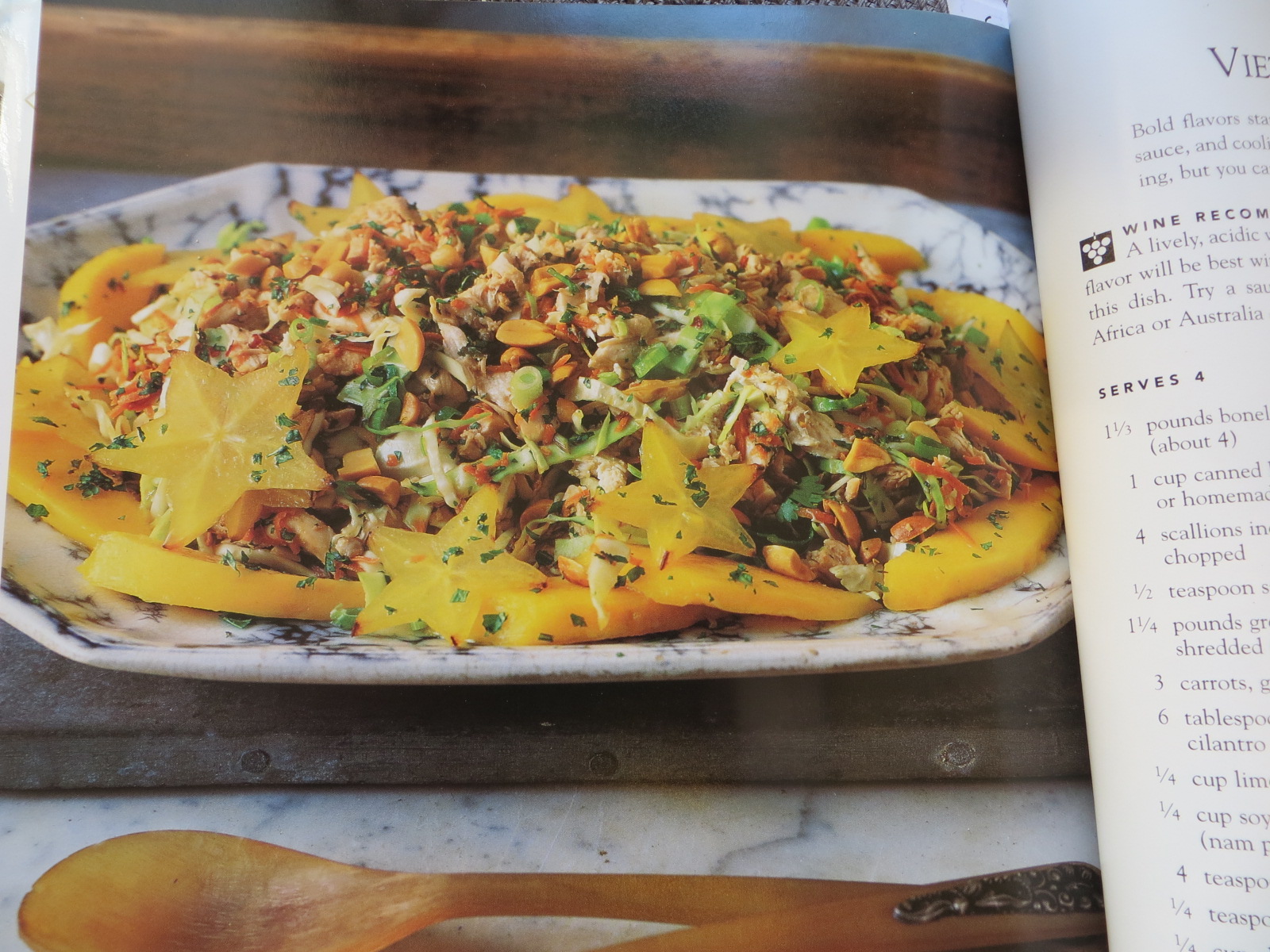
Vietnamese Chicken Salad [Quick From Scratch Chicken, Turkey & Cornish Hens]


What caught my eye with Quick From Scratch's Vietnamese Chicken Salad was the combination of fresh cilantro and mint, plus the inclusion of some reasonably authentic flavours. This is still a westernized recipe (I mean, it's from the 90s), but I think it turned out pretty well.

Cookbook Recipe:


Ingredients:
  • 1 1/3 lbs boneless, skinless chicken breasts (about 4 - I got a value pack and stashed the extras in the freezer)
  • 1 cup canned low-sodium chicken broth or homemade stock
  • 4 scallions, including green tops, chopped
  • 1/2 tsp salt
  • 1 1/4 lbs green cabbage, shredded (I got lucky at the grocery store, there was only one half-head of cabbage and it weighed that amount exactly)
  • 3 carrots, grated
  • 6 tbsp chopped fresh mint and/or cilantro (the cookbook says you can use one or the other if necessary, but they work great together)
  • 1/4 cup lime juice (2 limes worth)
  • 1/4 cup soy sauce or fish sauce (I went with soy sauce since it was on hand)
  • 4 tsp sugar (that's a lot of sugar)
  • 1/4 tsp red pepper flakes (that's not a lot of pepper flakes)
  • 1/4 cup chopped peanuts
Following the cookbook recipe exactly:


1. Cut each breast into five diagonal pieces. In a saucepan, bring the broth, 1/4 of the scallions, and 1/4 tsp salt. Bring to a simmer, add chicken, stir and cover. The recipe says to cook over a low heat for 5 minutes, but I found a medium heat was needed to make sure the chicken cooked. Turn the heat off and let the chicken steam for 5 minutes. I think this step is also to let it cool down for shredding, but it's still scalding hot when it comes out of the pan. Remove the chicken and shred it.


2. In a large bowl, combine the cabbage, carrots, rest of the scallions, chicken, and 4 tbsp of the mint and cilantro.


3. In a small bowl, whisk the lime juice, soy sauce, sugar, pepper flakes, and 1/4 tsp salt. Toss dressing in with salad. Top with the remaining herbs and the peanuts.

The Outcome:


This is pretty good! The flavours come together pretty well, though I think the lime juice comes through a bit sharp, though I have a feeling it will probably gel better after sitting in the fridge for a bit. While it's not a truly authentic Vietnamese recipe, it does have a lot of Vietnamese flavours, especially with the lime, soy sauce, cilantro, and peanuts. The mint adds some interesting depth, and it's generally a pretty healthy salad too. I could see myself making this again, especially for a potluck.

Of course, as always, it could use more chili.

1/4 tsp for the entire salad. Really.

Saturday, 17 October 2015

Spicy Chicken Chili [Quick from Scratch Chicken, Turkey & Cornish Hens]


I had originally wanted to make this cookbook's Groundnut Stew recipe but for the life of me couldn't find any okra, fresh or frozen, so I flipped the page and came to their Spicy Chicken Chili recipe. I love spicy food, usually peel-your-face off, but my gut instinct is that a recipe from the 90s isn't going to have any punch to it.

Cookbook Recipe:


Ingredients:
  • 2 tbsp cooking oil
  • 1 onion, chopped
  • 2 cloves garlic, minced
  • 1 pound skinless chicken thighs, cut into strips (I got them boneless as well)
  • 4 tsp chili powder (this is a pathetic amount of chili powder for a whole pot of chili. If I remake this recipe, it's going to be 4 tbsp)
  • 1 tbsp ground cumin
  • 2 tsp dried oregano
  • 1 tsp salt
  • 2 jalapeno pepper, seeds and ribs removed, chopped (another thing I hate - deseeding peppers. It just makes them less spicy. Again, if cooked again, I'd leave the seeds.)
  • 1 1/2 cups canned crush tomatoes with their juice
  • 2 1/2 cups canned low-sodium chicken broth or homemade stock
  • 1 2/3 cups drained and rinsed pinto beans (I had to substitute romano, but they're extremely similar)
  • 1 2/3 cups drained and rinsed black beans (both these beans are about the amounts in 443ml/15 oz can, but I could only find the larger cans, so I saved the extras)
  • 1/2 tsp fresh ground pepper
  • 1/3 cup chopped cilantro 
Following the cookbook recipe exactly:

1. In a large saucepan, heat the oil over moderately low heat. Sautee the onion and garlic until they start to soften, about 3 minutes.


2. Increase heat to medium, add chicken, cook until no longer pink, about 2 minutes.


3. Stir in the chili powder, cumin, oregano, and salt, then the jalapenos, tomatoes, and broth. Bring to a boil, reduce heat, cover, and simmer for 15 minutes.


4. Stir in beans and pepper, simmer uncovered for another 15 minutes. Top with cilantro.

The Outcome:


Unsurprisingly, this is not spicy. Like, not even a detectable tingle. The other spices are a bit light too, so the tomato flavour is much more dominant than in most chilies. It also has a much soupier consistency. If I was to remake this, I would cut it down to 2 cups of broth, at least an extra tsp or two of cumin, and just go hog wild with the chili powder. It's not bad, it's warm and hearty and easy to make, but it doesn't have zing. I'm going to reheat some of the leftovers later and add some ghost pepper sauce that I have in my fridge - that'll pick it right up!

Wednesday, 14 October 2015

Cornish Hens with Scallion Butter and Lime [Quick From Scratch Chicken, Turkey & Cornish Hens]


The question about this recipe is: did I fuck up or did the cookbook fuck up? The answer is kinda both, but while this second kitchen-tested recipe from the Quick From Scratch Chicken, Turkey & Cornish Hens cookbook wasn't a smashing success, it wasn't a complete disaster either.

The first problem I had was just getting cornish hens - I made the mistake of looking for them the day after (Canadian) Thanksgiving. Three grocery stores were plum out and the local butcher was closed. I managed to wrangle a pair of birds today, and reasonably successfully defrosted them with cold water. The combination of cumin, oregano, and lime really spoke to me in this recipe - they call it a "typical Mexican combination" in the cookbook, though I don't know if this is strictly a Mexican recipe.


Cookbook Recipe:

Ingredients:
  • 4 tbsp butter, room temperature (that's a lot of butter.)
  • 1 tsp dried oregano
  • 1 tsp cumin
  • 1/2 tsp salt
  • Fresh-ground black pepper
  • 2 cornish hens, 1 1/4 lbs approx each, halved
  • 1 scallion (green onion) including green top, chopped
  • lime wedges
Following the cookbook recipe exactly:

1. Heat the oven to 450 F. Combine 2 tbsp of the butter with the oregano, cumin, 1/4 tsp salt, and 1/4 tsp pepper. As in the Russian-Style Chicken Cutlets recipe, I would have preferred softened butter - maybe what counts as "room temperature" for a Canadian who keeps her house cold is a lot colder than this American cookbook thinks.


2. Rub the mixture on the skin of the hens and arrange them skin side up on a baking sheet. This is where two problems became apparent. The first was that the room temperature butter was so thick it sat like lumps on top of the hens and was impossible to rub over them. The second was my own problem - I just moved into a new place and it seems the baking sheets are too big for my new oven. I switched to a pyrex dish, which meant the hens had to sit more like they were whole and upright instead of spread out.

This is after the attempts at rubbing in.

3. The cookbook says to roast them in the upper third of the oven for 20 minutes, but even if they were spread out, that seems way too short. With them folded back together it took more like 45 minutes. I'd go for using a meat thermometer to test for doneness above what the cookbook says.

Even more butter

4. Combine 2 tbsp butter with the scallion, 1/4 tsp salt, 1/8 tsp pepper. Top the roasted hens with the butter and serve with lime.

The Outcome:


I don't know, I had to edit and substitute enough on this recipe that it's hard to nail it down. The combination of the cumin, lime, scallion, and oregano is really tasty - but you do need to baste the hens after the butter has melted or else you'll end up with dobs of concentrated spice. It's the second butter-heavy recipe from this cookbook, and while that much butter is delicious, I'm just two recipes in and already feeling greasy. I think the final verdict is that it was tasty, but it didn't justify the effort and hassle that went into it.